Second UAWOS Newsletter
Welcome
Welcome to the second UAWOS newsletter. We are pleased to have you join our community and share with you the latest developments and findings from our Horizon Europe project on contactless airborne river hydrometry. This newsletter will provide an overview of project activities and results, as well as in-depth information on specific topics, including practical guidance for field procedures. For more information, please visit our website at https://uawos.dtu.dk/, follow us on LinkedIn (#UAWOS), or contact us via email at pbg@ign.ku.dk.
UAWOS Progress Summary
UAWOS has successfully completed its second review cycle with the European Commission. Key achievements from the second project phase include:
- Acquisition, processing and sharing of comprehensive UAS hydrometry datasets from 8 different surveys focusing on 6 different rivers across Europe and Africa. All datasets are in the public domain and can be accessed at https://data.dtu.dk/projects/UAWOS/164815
- Development, testing and documentation of effective and cost-efficient UAS hydrometry surveying services for water surface elevation, river bathymetry and river surface velocimetry. All surveying protocols are documented in detail on our website (https://uawos.dtu.dk/Surveying-workflows) and in several scientific publications (https://uawos.dtu.dk/Publications).
- Systematic comparison of UAS radar altimetry data with satellite altimetry data from the SWOT and Sentinel missions across multiple river systems. This work is documented here https://uawos.dtu.dk/Satellite-EO.
- Combination of SWOT water surface elevation profiles, UAS hydrometry datasets, and hydraulic modeling for accurate river discharge estimation. We have published a proof-of-concept demonstration for the Torne River at the border between Sweden and Finland here (https://www.authorea.com/doi/full/10.22541/au.176348782.27152756/v2)
Recent Publications
We're pleased to announce three recent publications showcasing UAWOS research:
Hu et al. (2024) (https://doi.org/10.22541/essoar.175794211.10690810/v1): This paper showcases our fully contactless river discharge monitoring workflow, combining water surface elevation, river bathymetry and surface velocimetry datasets. The workflow has been applied and evaluated for a large and diverse set of river cross sections from rivers across Europe.
Zhou et al. (2025) (https://www.authorea.com/doi/full/10.22541/au.176348782.27152756/v2): This publication documents a proof-of-concept application on the Torne River in Sweden. We combine SWOT water surface elevation profiles, UAS hydrometry datasets, and hydraulic modeling to derive highly accurate estimates of river discharge. The workflow is independently validated using ICESat-2 water surface elevation data from May 2023. In this period, the Torne River was hit by a 100-year flood event, and our workflow estimated the peak flow in the river with an accuracy of just a few percent!
Zhou et al. (2026) (https://doi.org/10.22541/essoar.15002296/v1): This publication details significant refinements to our Doppler radar velocimetry workflows. By optimizing how we collect and process data, we’re aiming to improve the accuracy and efficiency of river monitoring. We put these workflows to the test across multiple rivers throughout Europe.
Explore our complete list of UAWOS publications here: https://uawos.dtu.dk/publications.
Data Highlights
UAWOS is committed to open data sharing. Datasets collected across our six use cases—Rönne River, Isar River, Orco/Po Rivers, Torne River, Ouémé River and Ogun River—are available for download in our data repository. Each dataset includes in-situ benchmark data and is provided at three processing levels: Level 1 (raw data), Level 2 (georeferenced point data), and Level 3 (data projected to the river centerline or cross-section). The following examples from the Orco survey illustrate the comparison between our UAS hydrometry data, satellite data, and ground truth measurements:
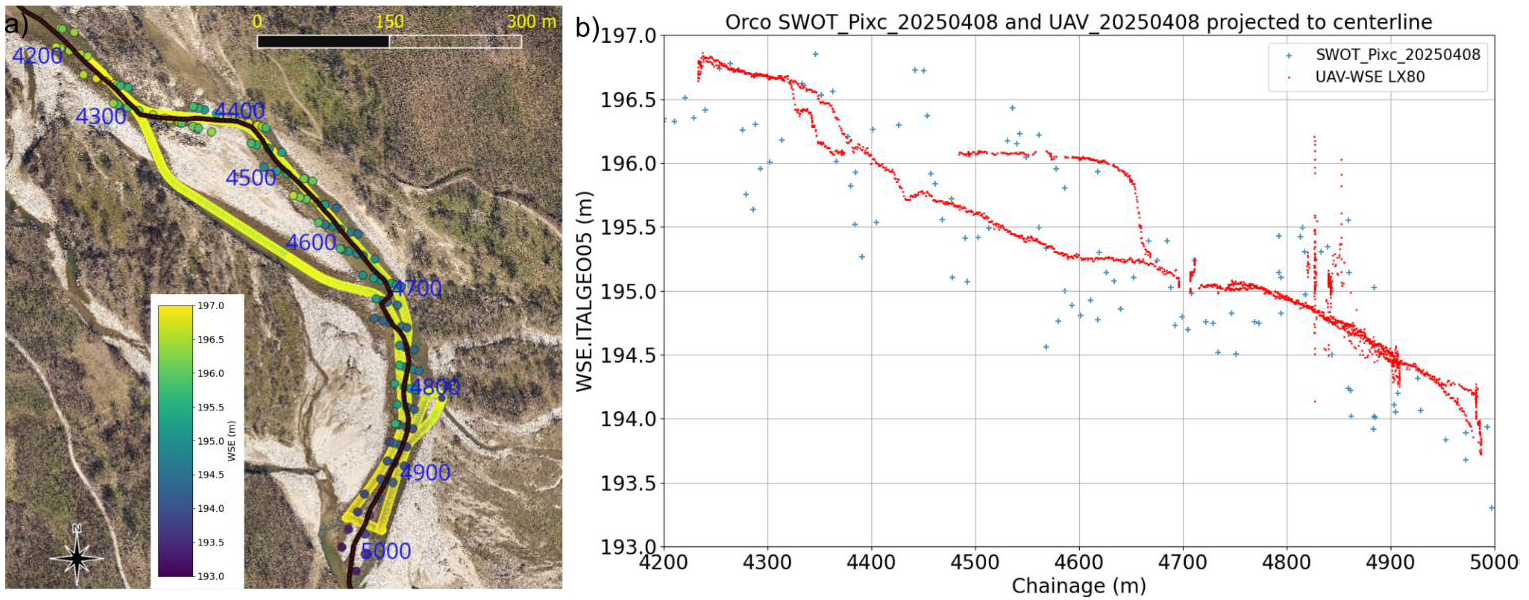
Water surface elevation mapped with the LX-80 radar altimeter in the Orco River. Note the difference in water surface elevation between the two river braids, which is due to the riffle-pool structure of the river. Discrete points in (a) and blue crosses in (b) are SWOT WSE data.

Doppler radar surface velocimetry for Orco River. Ground truth data from Flow tracker measurements are shown for comparison
Taking River Monitoring to the Next Horizon: Upcoming BVLOS Survey of the Isar River
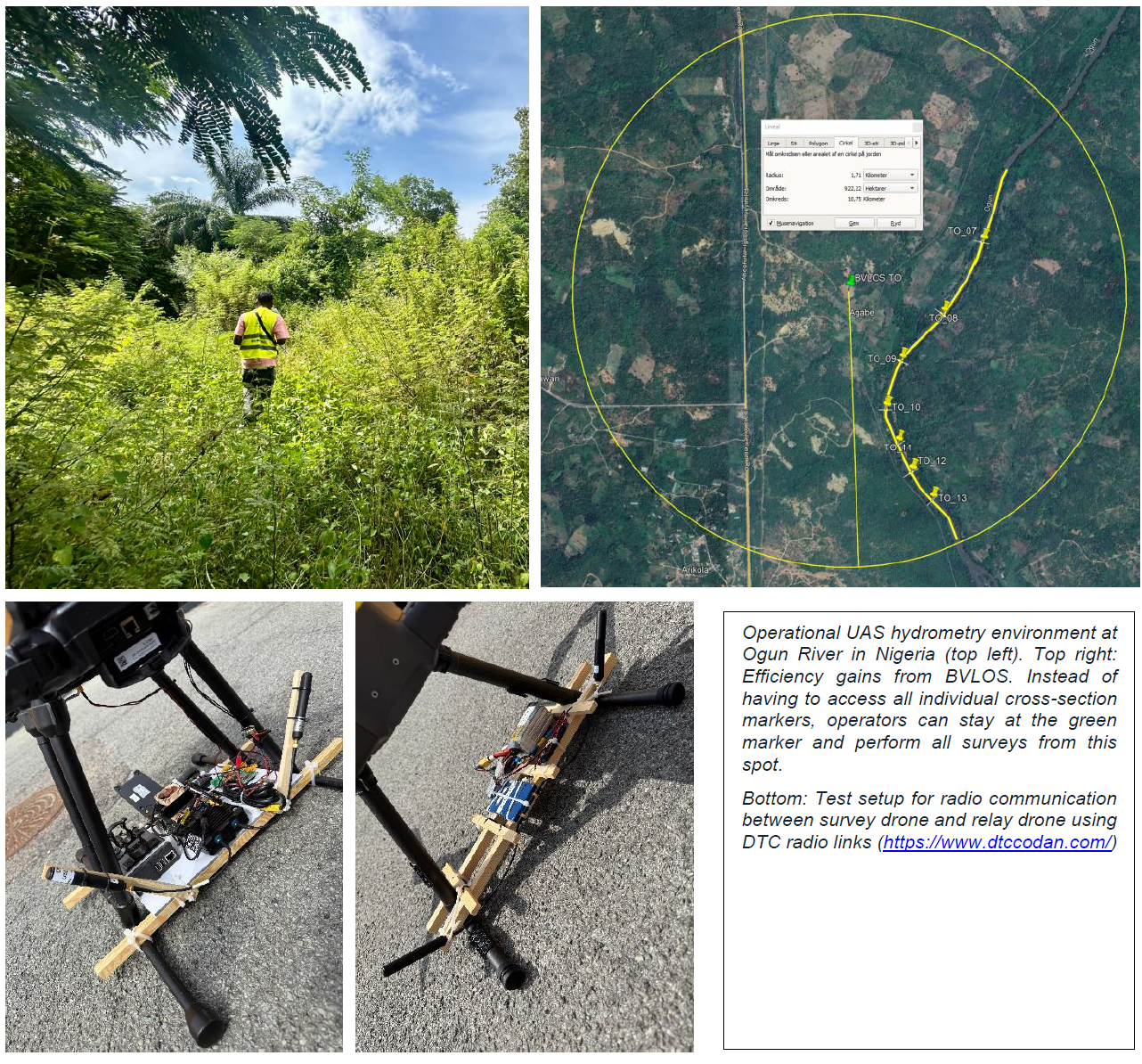
Our next big milestone in UAS hydrometry? An upcoming drone surveying campaign along Germany's iconic Isar River. But this isn't just another flight. This survey highlights a critical shift in how we observe water environments: the transition from VLOS (Visual Line of Sight) to BVLOS (Beyond Visual Line of Sight) operations.
To understand why this matters, we took a deep dive into the UAWOS Surveying Cost Model, which breaks down a river survey into five core components. The verdict? BVLOS is a game-changer for operational efficiency.
1. Planning: Goodbye Landowner Logistics, Hello Efficiency
Under traditional VLOS rules, pilots must keep the drone in sight at all times. For a river survey, this means meticulously planning accessible take-off locations close to the riverbank for every single cross-section. This often involves navigating private roads, negotiating permissions with multiple landowners, and painfully adjusting cross-sections when access is denied.
- The BVLOS Advantage: Physical access constraints virtually vanish. Because the drone can fly far beyond the pilot's view, we can plan extensive river surveys from just a few easily accessible hubs. This dramatically slashes planning hours, administrative friction, and overall preparation costs.
2. Travel & Accommodation: The Steady Baseline
Whether we fly within sight or over the horizon, our expert crew and specialized equipment still need to get to the river and stay nearby. The cost model shows that travel and accommodation needs remain largely identical between VLOS and BVLOS operations, making this the baseline anchor of the field campaign.
3. Equipment: Gearing Up for the Distance
BVLOS operations do require a slightly heavier hardware footprint. To ensure safe, continuous data streams over long distances, the equipment list expands to include:
- Relay drones and advanced communication relays.
- Increased battery capacity and robust mobile charging infrastructure to keep the drone airborne across extended river stretches. While this slightly increases initial equipment costs compared to a standard VLOS setup, the trade-off pays massive dividends during the actual flight.
4. Survey Execution: Unlocking Continuous Flow
This is where BVLOS truly shines. In a standard VLOS operation, the crew spends a frustrating amount of time packing up, driving to the next spot, and setting up again to measure individual cross-sections. This restriction heavily bottlenecks riverbed geometry (bathymetry) and flow velocity measurements, which must be captured precisely at fixed cross-section locations.
- The BVLOS Advantage: The physical boundaries are lifted. A single take-off allows the drone to sweep across multiple cross-sections in one fluid, continuous flight. The operational efficiency skyrockets. For the Isar survey, this means a significantly reduced cost per cross-section, alongside a more cost-effective sweep of Water Surface Elevation (WSE) per kilometer of the river.
5. Data Processing: Delivering the Insights
Once the drone lands, the data processing pipeline extracts key information from the UAS hydrometry data. Whether the data was captured down the stream or ten kilometers away, the workflow for processing, validating, and generating the final high-resolution hydrometric models remains identical.
By shifting our eyes from the local riverbank to the broader horizon, BVLOS allows UAWOS to deliver unprecedented spatial resolution at a fraction of the traditional cost and effort. Stay tuned for updates from our flights over the Isar River, as we continue to establish UAS hydrometry as the "new normal" for smart water governance and flood risk management!
Turning SWOT data into accurate river discharge with the help of UAS hydrometry and numerical modeling
Knowing how much water flows through a river matters to all of us: after heavy rainfall further up in the catchment, we want to know how much water will arrive a few days later? will our homes be safe? When the dry season begins, will there still be enough water to irrigate our fields? When driving a car, we read the dashboard to see how fast we are driving and whether we are accelerating or slowing down. Rivers also need a dashboard - a gauging station that tells us how much water flows through them each day. Yet in many parts of the world, rivers still have no such dashboard: no monitoring station and no continuous record of how they change over time. The Ouémé River in Benin, West Africa, is one of them.
River discharge cannot be measured simply by looking from the riverbank. A river may appear wide but be relatively shallow. Another may look much smaller while carrying more water through a deeper and faster moving channel. To understand how much water a river truly carries, we need to collect several critical clues: How much rain falls within the catchment, and how much of it eventually reaches the river? Once the water enters the channel, how wide and deep is the river? How quickly is the water moving? How does the water surface change along the river? Traditionally, we try to answer these questions using instruments on the ground. But in many places, riverbanks are difficult to reach, and rivers are difficult to enter safely. So, we began observing the river from different heights.
Our first assistant works from space. The SWOT satellite observes water surface elevation, river width and their changes along the channel. It gives us a new opportunity to monitor rivers over large areas, including places where little or no ground data were previously available. SWOT helps us answer questions such as: How wide is the river? How does its water surface change from one location to another? But SWOT also has limitations. It mainly sees the river surface. It cannot tell us how deep the channel is or how fast the water is moving. And because it observes Earth from space, smaller rivers and finer details can be difficult to capture. To fill in the missing information, we need to fly closer.
Fortunately, we have the second assistant: drone, or unoccupied aerial system (UAS). Equipped with different sensors, the UAS can reveal details that satellites cannot see. It measures water surface elevation, capturing finer changes in water level along the river. It measures surface flow velocity, showing how quickly the water moves at different locations. It also surveys river cross-sections, helping us understand the shape of the channel beneath the water surface. All together, these measurements describe the river’s capacity to transport water. However, SWOT and UAS observations capture only a few moments of a river. The next challenge is to connect these snapshots and reconstruct how the river changes from day to day.
Our third assistant is not from sky, it lives inside of our computer: We build a digital version of the river through hydrological and hydraulic models. The hydrological model describes how rainfall becomes river flow. Some water evaporates, some infiltrates into the soil, and some travels across the catchment before reaching the channel. To represent these processes, we use remotely sensed rainfall and temperature data from multiple satellite products. By combining these sources, we can account for their differences and obtain a more robust estimate. Once the water enters the river, the hydraulic model takes over. It calculates how quickly the water moves downstream, how high the water level rises, and how the shape and roughness of the river channel influence the flow.
The UAS provides detailed information at key river sections. SWOT contributes observations of the water surface along the river. Remote-sensing data on rainfall and temperature help us understand how much water comes and leaves within the catchment. The models connect all these clues and reconstruct how the river changes over time. Eventually, all sources of information allow a river without a dashboard to reveal itself.
In the Ouémé River case study, we successfully combined UAS observations, SWOT, ensemble remotely sensed rainfall and temperature data, and coupled hydrological-hydraulic modelling to estimate river discharge where ground observations are missing. During the validation period, the model achieved promising performance when compared with gauging-station records, with an NSE of 0.85 and a KGE of 0.71. So, when we ask whether a river without a dashboard can still reveal how much water it carries, the answer is becoming clearer - on the Ouémé River, we have taken an important step towards making that possible.

Conceptual Workflow for Discharge Estimation in Ungauged Catchments for Hydrological-Hydrodynamic Model Setup and Calibration
From Research to Market: The UAWOS Commercialization Success Story
A key objective of the UAWOS project is not just to innovate in the lab, but to bring advanced, contactless airborne hydrometric sensors directly into the global commercial marketplace. Through our consortium partner SPH Engineering, we are seeing this success story unfold in real time.
Looking at the commercial adoption of specialized SPH payloads, a striking trend emerges. Prior to the launch of UAWOS on February 1, 2023, and during our early development phase up to our first major demonstration survey in September 2024, market adoption was stable but modest. However, since that first successful UAWOS demonstration survey in September 2024, commercial demand has absolutely skyrocketed.
Commercial Payload Sales Milestones
|
SPH Payload |
Pre-UAWOS |
Early Project Phase (Feb 2023 - Sept 2024) |
Post-Demonstration Phase (Sept 2024 - Present) |
|
Echo Sounder |
45 |
17 |
100 |
|
Water Penetrating Radar (WPR) |
11 |
9 |
85 |
|
Radar Altimeter |
0 |
0 |
3 |
|
Doppler Radar |
0 |
0 |
2 |
The Proof is in the Data: Commercial sales of specialized Echo Sounders more than doubled their entire historical baseline in the period following our first field demonstration, while Water Penetrating Radar (WPR) units saw a near 8x increase.
Why This Growth Matters
The explosion in numbers - particularly for Echo Sounders (jumping to 100 units sold) and Water Penetrating Radar (surging to 85 units)—proves that the industry has been waiting for verified, drone-integrated hydrological sensors. Furthermore, we are seeing the absolute earliest commercial entries of cutting-edge Radar Altimeters and Doppler Radars into client fleets. These highly specific payloads are critical for executing the contactless, high-precision water surface elevation and flow velocity measurements pioneered by UAWOS.
When enterprise drone operators and environmental agencies see these technologies working seamlessly in real-world river catchments, it removes the proof-of-concept barrier. This isn’t just future tech anymore—the industry is actively buying, scaling, and deploying UAWOS-backed hardware to map the world's waterways today.